
Why do we not include the Luminous or John Paul II Mysteries?
The following is from a letter that we received from the Fatima Center, and explains the reasons why we have decided to present the fifteen mysteries of the Holy Rosary of the Blessed Virgin Mary instead of the chaplet of John Paul II.
Our Lady gave the Rosary to St. Dominic in the thirteenth century after he prayed to Her and asked Her help in fighting a terrible heresy which had invaded the Church. By the time Our Lady handed the Rosary to St. Dominic, it was already an established form of prayer for Catholic clergy and lay faithful.
The history of the Rosary is intertwined with that of the 150 Psalms of the Old Testament, otherwise known as the "Psalter of David". From the earliest days of the Church the Psalms were prayed by monks and hermits as part of their daily liturgical life. The monks of the desert prayed all 150 Psalms daily.
In the 5th century St. Benedict arranged the Psalms for his monks so that they prayed all 150 in a week (today this is known as the Divine Office). Around the 7th century Irish monks divided the 150 Psalms of David into a format of three groups of fifty.
Because of their great love for Our Lady the people of the Middle Ages began composing "Rosariums" in Her honor. They composed Psalms in praise of Our Lady to match the 150 Psalms of David. In the twelfth century St. Anselm of Canterbury made such a Rosary.
Shortly thereafter, the custom of reciting Hail Marys was substituted in place of reciting the Psalms in praise of Our Lady. The Redemptorist Father James Galvin wrote "By the 13th century, the number of Aves (Hail Marys) was set at one hundred and fifty to equal the number of the Psalms of David."
St. Thomas Aquinas explains that the Psalter of David, composed of one hundred and fifty Psalms, is divided into three equal parts of fifty Psalms each. "These three equal parts represent (figuratively) the three stages in which the faithful find themselves: the state of penance, the state of justice, the state of glory."
Likewise, explains Father Anthony Fuerst, in his book This Rosary, "the Rosary of Mary is divided into three parts of fifty Hail Marys each in order to express fully the phases of the life of the faithful: penance, justice and glory."
When Our Lady appeared to St. Dominic, he had been fasting for three days and nights. Our Lady was accompanied by three angels. She said "Dear Dominic, do you know which weapon the Blessed Trinity wants to use to reform the world?"...
St. Dominic asked Her to tell him and Our Lady responded: "I want you to know that, in this kind of warfare, the battering ram has always been the Angelic Psalter which is the foundation stone of the New Testament. Therefore if you want to reach these hardened souls and win them over to God, preach my Psalter."
Our Lady's words contain two special points of interest:
1) She uses the language of the Church militant. She does not speak of the Rosary in a sentimental manner in order to achieve good feelings... No, She refers to it as a battering ram against heresy.
2) She twice uses the term "Psalter", which is the Rosary designated as 150 Aves that link it to the Psalms of David.
Regarding the Rosary's traditional structure, Msgr. George Shea writes, "Because it's 150 Hail Marys correspond to the 150 Psalms of the Psalter, the complete Rosary is sometimes called 'Our Lady's Psalter.' "
In handing the Rosary to St. Dominic, Our Lady took Her Psalter and and placed it into our hands via St. Dominic, thereby putting Her seal of approval on the practice that had been established in the Church, and strongly encouraged it's practice in order to defeat heresy and other evils.
Our Lady's Psalter is known by many names, such as: the Angelic Psalter, the Holy Rosary of the Blessed Virgin Mary, and of course, the Dominican Rosary, to name a few. This last name was given because of the saint to whom the Queen of Heaven condescended to give Her Psalter to us through.
The widespread practice of the Rosary did indeed defeat the Albigensian heresy, that St. Dominic was working so hard to eliminate.
As you know, the Dominican Rosary consists of 15 decades or 3 sets of mysteries - Joyful, Sorrowful, Glorious - of 5 decades each.
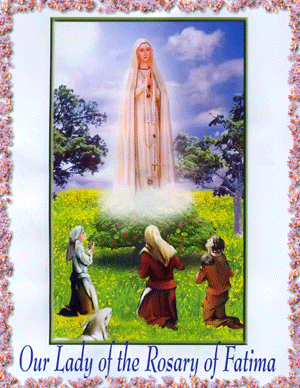
Once this devotion was established in the Church and given Our Lady's seal of approval, the only person to ever make a change to the Holy Rosary of the Blessed Virgin Mary is Our Lady, Herself, when She came to Fatima. She added what is called the Fatima Decade prayer - i.e. "Oh my Jesus, forgive us our sins..."
In fact, in the Message of Fatima, Our Lady reinforced that there are only fifteen mysteries, when She asked for the First Saturday Communion of Reparation to Her Immaculate Heart. As part of the First Saturday reparation, Our Lady asked us to meditate "fifteen minutes on the 15 mysteries of the Rosary."
Surely the Mother of God, Who told the child seers at Fatima that World War I would end, Who warned of the coming of World War II, Who told the name of the Pope that would be on the seat of Peter at the onset of that war, Who foretold a miracle that would be performed three months in advance so that all would know that She was indeed appearing at Fatima, surely She also knew that there would be a Pope who would introduce another chaplet. Yet She did not say, for now meditate on the 15 mysteries and in the future, there will be 20.
Over the centuries there have been other chaplets that have been introduced, but have never become part of the Dominican Rosary. For example:
1) Centuries ago, the Franciscans started the practice of the "little rosary" or chaplet of the Seven Joys of Our Lady.
2) Also, centuries ago, the Servites began the "little rosary" or chaplet of the Seven Sorrows of the Blessed Virgin Mary.
3) Likewise, some years ago, Pope John Paul II introduced something new called the Luminous mysteries.
Unfortunately, many have been misled into believing the chaplet of John Paul II is part of the Dominican Rosary and feel compelled to incorporate it as such. This is unfortunate, since it should never be presumed that any one of us, not even a Pope, can "improve" on or change, that which was given to us directly from Heaven.
Pope Paul VI, it seems, understood this. In 1972, when it was suggested on a number of occasions by Archbishop Anibale Bugnini, Secretary of the Congregation for Divine Worship, to Pope Paul VI that His Holiness make or allow changes to the Holy Rosary of the Blessed Virgin Mary, Pope Paul VI absolutely refused to do such a thing, acknowledging what a mistake that would be.
Pope Paul VI said, "The Rosary is to remain single in form and unchanged from what it now is (1972). Let any new forms of Marian devotion ... take their place alongside the Rosary." Which is precisely the point to be made regarding the Luminous mysteries. Let them take their place alongside the Dominican Rosary, exclusive of, and not as apart of, the Dominican or Holy Rosary of the Blessed Virgin Mary.
Pope Paul VI was reinforcing the Rosary as is, which is also what his predecessors had done. The Popes throughout the centuries have consistently used the term "Psalter" of Mary, with it's 150 Hail Marys (in the fifteen decades), as a link to the 150 Psalms of David.
At Fatima, Our Lady asked us through the child seers, to recite daily "a third of the Rosary" (referring to the fact that there are 15 mysteries - 5 decades for each of the 3 sets of mysteries - either Joyful, Sorrowful or Glorious.)
However, for those who erroneously seem determined to incorporate the Luminous Mysteries of John Paul II as if it were part of the Dominican Rosary, promoting it as if there are now twenty mysteries to Our Lady's Psalter, books that include the Luminous mysteries and Our Lady's words will need to explain what Our Lady meant when She said "a third of the Rosary" - a third - "um terco", that is how the Portuguese speak about the 5 decades of the Rosary.
Our Lady certainly did not mean 6.66 decades of the Rosary, which is what a third of 20 is....
It cannot be stressed enough how important it is for each one of us to pray at least 5 decades, i.e. one set of mysteries, of the Holy Rosary of the Blessed Virgin Mary, daily...
The most powerful form of prayer after the Holy Sacrifice of the Mass, is the Holy Rosary of the Blessed Virgin Mary. All else, except the Divine Office, all other prayers pale in comparison.
Our Lady of Fatima made it clear, "God wishes to establish in the world devotion to my Immaculate Heart." The devotion most pleasing to Our Lady (which She also made clear 800 years ago to St. Dominic) is Her Psalter or Holy Rosary.
She made it clear to sister Lucy, that the Rosary is THE way to keep from falling into heresy, sin, error, etc... And it is THE way to recognize, and overcome heresy, sin, error, etc... The Rosary is the best way and should take precedence over all other devotions.
So if you only have 30 minutes a day to pray (although the saints tell us we must pray a great deal in order to save our souls), please, for your sake, for the sake of your family, for the sake of the world, make sure you are praying the Holy Rosary of the Blessed Virgin Mary.
And for those who insist on thinking that the Luminous mysteries should be prayed - on the day you pray the Luminous mysteries - make sure you also pray another 5 decades of the Rosary that Our Lady gave us - i.e. either Joyful, Sorrowful or Glorious.
For more information about Our Lady of Fatima visit The Fatima Network